|
|
Why nailheads?
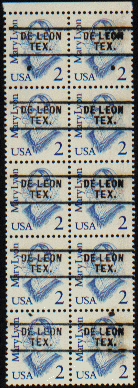
They're on the precancels! Look for two round nailheads below the precancels on row 1 and two more nailheads above the precancels on row 5.
See the Frequently Asked Questions for another illustration and more information on nailhead precancels.
|
|
New "Nailhead" Navigation Legend
|
| •
|
|
Home Page |
| •
|
|
Site Map |
| •
|
|
Links |
| •
|
|
Precancel Index |
| •
|
|
Club Index |
| •
|
|
Awards Index |
Nailhead Position
• Return
You are here •
You are below this link in a category page
•
•
Go to top of page
Sliding position:
bottom of pages
e.g., if you are on page 3
1 2 •3• 4 5
|
|
|
|
| PSS Town and Type Precancel Catalog footnotes |
1 = Counterfeits exist.
2 = copies normally perfinned, creased or with poor impressions. Type is priced with these conditions present.
3 = Font variations exist in some or all positions within the device. In a few cases, when necessary to distinguish between two devices of the same style, the letters that are in the wrong font are stated in the following format: (3,xx,yy) where xx and yy are the letters that are in the wrong format on the left side of the device and the right side of the device, respectively. One example is SARALAND, AL which has two 841 devices that are distinguished in this way.
4 = Line spacings vary within the device by more than a 1/2 mm.
5 = Punctuation variations exist within the device.
6 = device differs slightly from Standard Style illustraton/description.
7 = Repair exists which differs in font, spacing or punctuation from the rest of the device.
8 = Various dates exist. This footnote is not used for Integral dated control types for which various dates is the norm. (SEE TYPESET PRECANCELS.)
9 = This not is used when one or more, but not all, positions of the device have a variant spelling. When space permits, the variant spelling follows the (9), as in Baltimore, MD, L-6TS(9,OER). If all positions are misspelled, the misspelled portion appears in the brackets following the type designation, without reference to Footnote 9, as in Citronelle, AL 841(LLA).
10 = This note is used when one or more, but not all positions of the device have the wrong state name. When space permits, the wrong state name follows the (10), as in Wabbaseka, AR 841(3,10,AK). If all positions are wrong, the wrong portion appears in the brackets following the type designation, without reference to Footnote 10, as in Moriarty, NM 841(MN).
11 = Two or more devices of the type exist, but the differences, if any, do not justify separate listings under catalog guidelines.
12 = Later usage of device shows worn impressions which distort measurements.
13 = legitimately used but philatelic in origin and usually controlled in distribution
14 = The device contains one or more positions in which either the town or state is inverted.
15 = The device contains one or more positions in which the state is over the town.
16 = The device contains one or more positions which lack any identification of the state.
(ERROR STATE MAY HAVE BEEN REMOVED.)
17 = Some of the imprints appear to be press printed. This note is for use with types that are normally hand applied.
18 = Hand applied impressions of this device are known to exist. This note is for use with types that are normally press printed.
19 = Device also used for postcancelling. Price applies to precanceled specimens.
20 = This footnote is used when there are two devices of the same style, one of which has the state name abbreviated and the other has it spelled out. the footnote goes with the device that has the name spelled out. (Old literature uses SNIF for State Name In Full.)
21 = Some positions of the device have either the bottom line or the top line misplaced so that it appears between the town and the state.
22 = The device contains at least one position which has the town repeated in the position where the state normally appears.
23 = usually lacks lines, see Porterville, CA 704, Trinidad, CO 703
|
Town and state alignment are mentioned in the PSS Town and Type catalog only when needed to separate devices. State shift (rarely town shift) varieties will be broken out in this website where known and distinguishable.
Many more PSS Town and Type Catalog ground rules are in the preface, but the dimension shorthand and footnotes are frequently used as a convention and the detail listings on this website. This does not preclude using the PSS Town and Type catalog and/or Town and Type CD as complete references.
|
| Shorthand letters used in dimension references by PSS |
a = distance between town and state
b = distance between bottom of state and inside of lower line (or bar)
c = overall length of town, including punctuation, if any
d = distance between insides of top and bottom lines (or bars) (NOT CENTER TO CENTER)
e = distance between top of town and bottom of state
f = overall height from bottom of lower line (bar) to top of upper line (bar) (outer to outer)
g = distance between 1st and 2nd word of town (two word towns only)
h = length of top and bottom bar, which are assumed to be equal (does not apply to types within lines)
s = length of state, including punctuation, if any
t = distance from top of town to inside of the top line (or bar)
w = width of top and bottom line (or bar), which are assumed to be equal
x = for types with double lines (bars), the distance between (inside gap) each pair, which are assumed to be equal
z = distance from top of line to bottom of dated control
|
|




